

CTE student readiness requires more than technical skills. You know the feeling. Graduation happens. Placement rates look good. Yet employers consistently give the same feedback: your graduates are technically competent but cannot think on their feet.
Not every graduate. However, enough that you notice the pattern.
The problem affecting CTE student readiness is not your teaching. It is that you cannot see how your students actually think under pressure. Therefore, you cannot measure CTE student readiness. As a result, you cannot improve it.
Most CTE programs use rubrics. Teachers observe students doing labs or projects and score them: developing, proficient, advanced. Two teachers will score the same student completely differently. In fact, what you are really measuring is teacher impression, not student ability.
Employers evaluate differently. They watch how a student handles a patient who is anxious. Meanwhile, they observe how the student solves a customer problem that is not in the script. Additionally, they assess how the student approaches a technical issue the manual does not cover. They are evaluating judgment. By contrast, your rubrics evaluate compliance.
The question is: which one matters?
How One Program Fixed This
York Tech in Pennsylvania had a similar challenge in its teacher preparation program. These pre-service teachers had mastered education theory. But when they stepped into a classroom, they froze. For instance, how do you handle a difficult parent conversation? What happens when a student challenges your authority? And how do you communicate clearly under pressure?
Traditional role playing was scripted and predictable. Teachers memorized responses instead of learning to think in the moment.
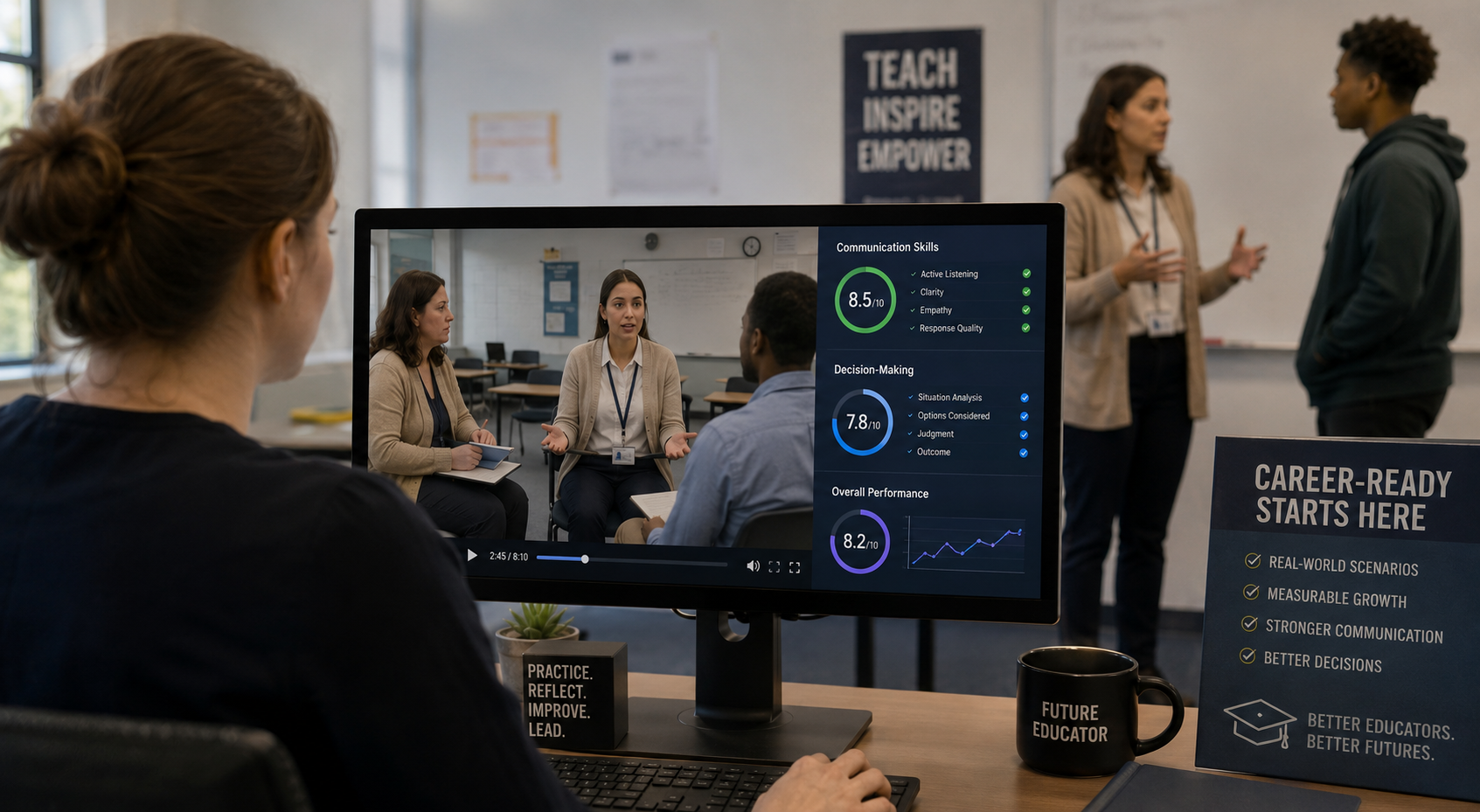
York Tech started using MegaMinds. Pre-service teachers practiced in realistic 3D classroom scenarios. MegaMinds’ Interactive Characters took on the roles of difficult parents, challenging students, and peer observers. Every conversation was dynamic and required participants to think, communicate, and make decisions in real time rather than rely on memorized responses.
Every interaction was recorded. Pre-service teachers could review exactly what they said, how they communicated, what decisions they made. They could see their own thinking patterns.
Results were immediate and measurable.
Engagement: 8.8 out of 10. Participants reported sustained focus and genuine participation throughout high-stakes communication scenarios.
Realism: 7.8 out of 10. Participants consistently rated interactions with the Interactive Characters as more authentic than traditional role playing.
Effectiveness: 8.5 out of 10. Pre-service teachers reported feeling substantially more prepared for real classroom interactions with parents and students.
Adoption: 85% of participants preferred simulation-based practice. They cited superior relevance and the ability to rehearse complex decisions without real-world consequences.
This was engagement paired with measurable improvement in how teachers thought and communicated under pressure.
Want to see the full York Tech case study? Read the complete case study here
The Strategic Result
Under the leadership of Dr. Melissa-Ann Pero, York Tech realized the bottleneck was not curriculum. Rather, it was the medium. Pre-service teachers could now rehearse the emotional and interpersonal complexities of teaching repeatedly. Consequently, they did not have to imagine the classroom. Instead, they operated within it.
Why CTE Student Readiness Matters for Your Program
Your students are in a similar situation. They can execute procedures in labs. However, can they handle judgment calls in real workplace scenarios?
Traditional assessment cannot answer that question. Rubrics measure if students completed steps correctly. They do not measure if students can think when something unexpected happens.
When students practice in realistic scenarios and their thinking is recorded, teachers see patterns. For example, which students communicate clearly under pressure. Additionally, which students adjust when the situation changes. In sum, teachers see evidence, not subjective impressions.
Instruction improves because it targets what students actually need. Students who struggle with clarifying questions get targeted coaching. Those who make good decisions but communicate poorly get feedback on clarity. As a result, improvement is faster because feedback is specific.
Employers notice when graduates actually think clearly and make good decisions. Graduate retention improves. Some employers start specifically requesting graduates from programs that produce workplace-ready students.
To put it differently, this is what objective assessment enables.
Why Most CTE Programs Do Not Have CTE Student Readiness Measurement
Objective measurement of soft skills requires:
One: Realistic scenarios where the skill is required. Not simulations that feel like games. Scenarios that mirror actual workplace decision-making and pressure.
Two: Recording of what actually happened. Not teacher observation. Structured data showing what the student said, what they decided, how they communicated.
Three: Organized data teachers can actually use. Not hours of video analysis. Dashboards that show patterns and highlight where students need help.
Four: Integration with your existing assessment and reporting systems. Not a separate disconnected platform.
Five: Protection of student data. Family Educational Rights and Privacy Act (FERPA) and Children’s Online Privacy Protection Act (COPPA) compliant. Student data and recorded interactions are never used to train external models.
Most CTE programs cannot build this infrastructure. So they rely on rubrics and teacher observation.
MegaMinds was built to solve this. Fully FERPA and COPPA compliant. Learn more at MegaMinds Privacy Policy.
Why This Matters Right Now
You have employers who will hire from you if graduates are reliably workplace ready. You also have employers who stopped calling because they got burned by inconsistent graduate quality.
Every cohort you graduate unprepared damages your reputation. Word travels.
The fix is not more courses. It is not harder training. It is visibility into how students actually think so you can intervene before graduation and improve what matters.
York Tech demonstrated what is possible. Their pre-service teachers showed measurable improvement in how they thought, communicated, and responded to pressure. The results demonstrate that immersive simulation based practice can measurably improve communication, judgment, and decision making under pressure.
The question is not whether this is possible. The question is how long you want to wait before you know which of your students are actually workplace ready.
Ready to See This in Action?
We will show you exactly what this looks like:
How pre-service teachers at York Tech went from scripted role playing to thinking clearly under pressure.
What they could see about their own communication and decision making through recorded scenarios.
How measurable assessment changed how they prepared for the classroom.
No sales pitch. Just a practical look at how immersive simulations and Interactive Characters help educators observe, assess, and improve workplace readiness before students graduate.
Book a Demo and see how MegaMinds helps you assess workplace readiness before graduation.