

“The goal isn’t to capture attention with entertainment. It’s to build attention over time through deliberate design.”
Teachers across the country are sounding the alarm: students can’t focus like they used to. But what if the problem isn’t attention spans? What if it’s how we design learning?
Recent research tells a striking story. Eighty-eight percent of teachers in an international survey of more than 3,000 educators believe their students’ attention spans are getting shorter (The Hechinger Report, 2026). In U.S. kindergarten through second-grade classrooms, 75 percent of teachers report attention spans have declined since the COVID pandemic, when laptop and technology use expanded rapidly.
The real story, though, isn’t declining. It’s a mismatch.
Schools are still built on a model that demands long stretches of passive listening. But students today have been conditioned by a different reality: short-form content, rapid context switching, and the expectation of interaction. The solution isn’t to blame students or technology. It’s to redesign how learning actually happens.
And teachers are already showing us the way.
What’s Actually Happening to Attention
Attention hasn’t disappeared. It’s been retrained by the environment.
Students today grow up with short-form content like TikTok videos and rapid context switching across devices. This creates what looks like declining focus but is really something else: students have been optimized for a different type of attention. They can hyper-focus on things that demand interaction and immediate feedback. They struggle with sustained, passive consumption.
This isn’t a permanent deficit. It’s a mismatch between how brains are operating now and what classrooms still demand.
The evidence is clear in classrooms. One eighth grader described her experience plainly: when the teacher talks at the front of the class, she can pay attention for about 20 minutes. After that, she loses interest. But when the class shifts to group work or interactive activities, her engagement returns (The Hechinger Report, 2026). This pattern repeats across students and schools. Passive listening has a short window. Interactive work extends it.
The key insight: Students aren’t incapable of focus. They’re conditioned to expect environments that demand and build it.
The Real Problem: Instruction Hasn’t Adapted
Classrooms are still designed for long, passive attention. The model looks like this:
- 45 minute lecture or lesson block
- Students listen while the teacher delivers content
- Single format: direct instruction
- Assessment: what students remember after listening
But attention doesn’t work that way anymore. More fundamentally, it never worked that way for most students. We’ve just been tolerating the gap between how classrooms are designed and how learning actually happens.
The contrast is stark. Attention operates in cycles. Engagement requires interaction, not just information. Cognitive load has to be managed intentionally. We’re asking students to learn in ways that exceed even adult attention spans.
The solution isn’t to make learning easier. It’s to redesign it for how brains actually work.
What Teachers Are Already Doing (And It’s Working)
Here’s where the story shifts from problem to solution.
Teachers aren’t waiting for permission or policy changes. They’re redesigning their classrooms around what actually works. At McKinley STEAM Academy in Toledo, Ohio, and schools across the country, educators are implementing clear patterns (The Hechinger Report, 2026):
Microlessons
One teacher breaks her lessons into smaller units called microlessons. Another student’s experience shows why this matters. When she moves from a direct lecture format to interactive activity, the concept becomes memorable. In a fifth grade science class, instead of describing Earth’s rotation and revolution, students physically walked in circles around the teacher, embodying the concept. The next day, the student could recite the distinction clearly: “Rotation is light and night, and it takes 24 hours. Revolution is going around one year, 365 days and a quarter” (The Hechinger Report, 2026).
The shift from passive delivery to active embodiment made the concept stick.
Brain Breaks
When a critical mass of students starts losing focus, teachers are inserting movement and physical resets. Ten jumping jacks. A quick stretch. Even a minute of deliberate breathing. These aren’t distractions from learning. They’re resets that allow students to refocus for the next learning cycle. As one first-grade teacher put it: “Any way to get up and move, reset their brains so they can sit down and focus for a couple more minutes” (The Hechinger Report, 2026).
Hands-On Learning
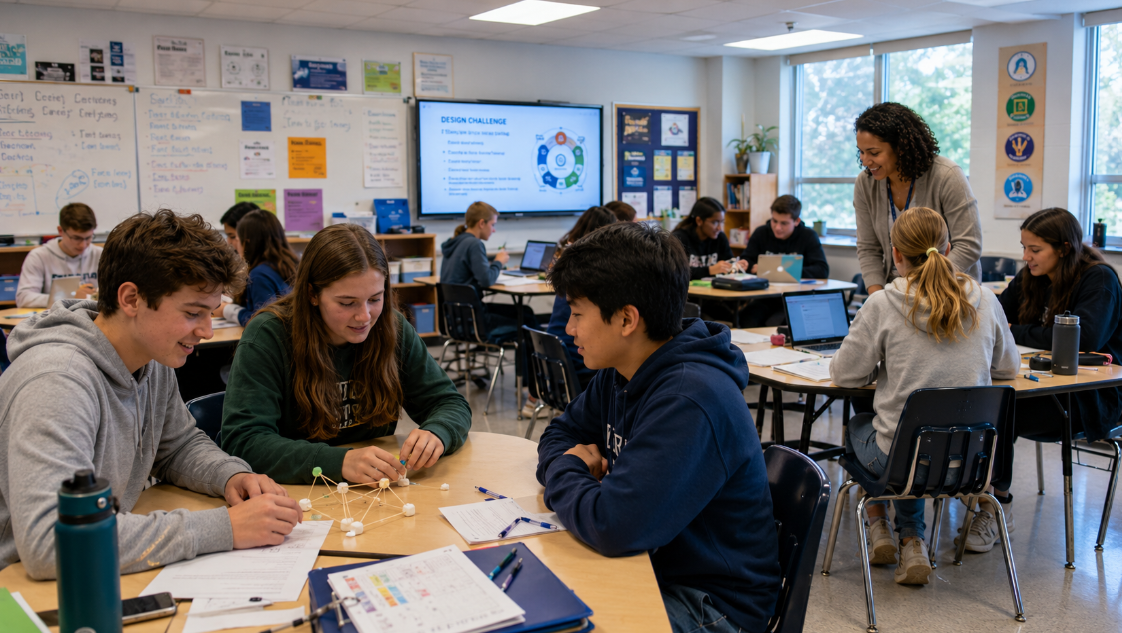
Worksheets and passive listening have given way to interactive activities: building with physical materials, role-playing scenarios, solving problems in groups, creating things. Students don’t just absorb; they act. This active engagement keeps attention strong and makes learning memorable. At McKinley STEAM, eighth graders used marshmallows and candy to work through genetics problems, determining offspring traits based on parent characteristics (The Hechinger Report, 2026).
Repetition and Spaced Exposure
Teachers understand that memory doesn’t consolidate from a single exposure. As LSU psychology professor Emily Elliott explains: “Our memories take time to consolidate. The more times that you are exposed to something, you learn it, you have to try to remember it. You practice retrieving it, and then you have a break. Then you do something else and come back and try again. That’s strengthening your neural network” (The Hechinger Report, 2026).
Teachers are designing lessons that return to concepts multiple times across days and weeks, with retrieval practice built in.
Transparency with Students
Teachers are being explicit about effort. They tell students how long they’ll need to focus on a difficult task, why they’re doing it, and when they can shift to something else. Students respond when they understand the contract. They’re more willing to engage in sustained effort when they know what to expect (The Hechinger Report, 2026).
Mindfulness and Self-Regulation
Meditation, breathing exercises, and affirmations aren’t add-ons. They’re foundational. In one kindergarten classroom, the day begins with guided meditation and students proclaiming what they’re capable of. These practices build the cognitive infrastructure for attention (The Hechinger Report, 2026).
The common thread: None of these tactics are expensive or complex. They’re redesigns of structure and rhythm. And they’re working.
The Non-Obvious Insight: Attention Is Trainable
Here’s what this tells us: Attention is not a fixed trait. It’s a muscle built through structured effort.
The goal isn’t to capture attention with entertainment. It’s to build attention over time through deliberate design.
This changes everything about how we think about the problem. If students’ shorter attention spans are partly a result of how they’ve been conditioned by their environment, then attention can be reconditioned. The path isn’t medical (something’s wrong with their brains) or moral (students are lazy). It’s structural: the classroom environment can demand and develop sustained focus.
Learning requires repeated exposure and retrieval cycles. Each cycle strengthens the neural networks that support attention. When teachers design lessons with this mechanism in mind, students don’t just learn content. They build the capacity for focus itself.
The Shift: From Content Delivery to Attention Design
This points to a fundamental pivot in how education needs to work.
Old Model: Content Delivery
- Teacher prepares content
- Teacher delivers it
- Student receives it
- Success equals information transferred
New Model: Attention Loop Design
- Engage (activate interest, set clear expectations)
- Act (students do something with the content)
- Reset (cognitive break, physical movement, context shift)
- Re-engage (return to the concept, build on it)
The future of learning isn’t longer about attention. It’s better-designed attention cycles.
This matters because it reframes the entire problem. It’s not about fighting technology or blaming screen time. It’s about acknowledging how students’ brains are operating now and designing learning environments that work with that reality, not against it.
Why This Matters for the Future of Learning
Several implications follow:
Engagement is now foundational, not optional.
In older models, engagement was nice-to-have. Now it’s structural. Without interactive, well-designed cycles, learning doesn’t stick. Teachers can’t rely on passive attention anymore because passive attention doesn’t produce learning.
Passive learning is fundamentally misaligned with cognition.
We know now (through research and classroom evidence) that sustained passive consumption doesn’t work for memory consolidation, for building skills, or for developing the capacity to focus. The traditional lecture model was always less effective than we pretended. Now we have no excuse for using it as the default.
“Edutainment” is emerging but it’s misunderstood.
When educators talk about making learning more engaging or interactive, it’s not about sugar-coating lessons or entertainment for its own sake. It’s about making learning effortful and active. Interactivity creates the cognitive load and retrieval practice that actually builds memory and understanding.
As one superintendent explained: “How can you make your lesson applicable, interactive? Teachers are going to have to be more engaging for students” (The Hechinger Report, 2026). That doesn’t mean more fun. It means more interactive, more decision-focused, more oriented toward active problem-solving.
Where This Is Going: The Next Generation of Learning
The evidence points clearly to what comes next. Schools that are successfully redesigning instruction around attention are building toward a specific vision of learning.
Interactive by default. Students don’t passively receive information. They engage with scenarios, problems, and decisions that require their reasoning and action.
Scenario based. Learning moves beyond abstract content to situations students recognize and care about. Career simulations. Real world problems. Situations where their decisions matter.
Built around practice and feedback. Students attempt something, receive immediate feedback, adjust, and try again. This cycle strengthens both understanding and focus.
Designed for repetition and spacing. Memory consolidates through exposure over time. Concepts return across days and weeks, each encounter at a deeper level.
This is what one superintendent meant by “edutainment.” Not entertainment, but learning structured so students must think, decide, and act. Teachers increasingly need platforms that let them deliver this kind of instruction consistently, across entire classes, without spending weeks designing customized experiences for each student.
What this looks like in practice:
Simulations where students practice authentic decisions and receive feedback on their thinking. A healthcare worker triaging patients. A job candidate navigating an interview. An engineer solving a real problem.
Scenario based learning where concepts are embedded in situations, not isolated facts. Students learn physics through scenarios that demand it. They develop communication skills through situations that require it.
Iterative practice environments where students engage with problems, see feedback, adjust their approach, and try again. Low stakes. Repeated. Focused on building fluency and confidence.
Real time data that shows teachers how students are reasoning through problems, not just whether they got answers right or wrong. This enables adjustment and targeted support in the moment.
The schools doing this work are proving something critical: when the environment is designed for how attention and memory actually work, engagement improves, focus builds, and learning sticks.
The Broader Shift: From Productivity to Learning
Most educational technology tools focus on teacher productivity: generating lesson plans, automating grading, and creating content faster. Those tools serve teachers.
But the attention crisis we’re seeing isn’t a teacher productivity problem. It’s a learning design problem. Students aren’t disengaged because teachers aren’t working hard enough. They’re disengaged because the structure of learning doesn’t match how their brains operate.
The tools that matter now are those that enable better learning design that make it easy to deliver interactive, repetition based learning at scale. Not tools that save teachers time on busywork. Tools that let teachers implement what actually works.
The Reframe
Step back from the headlines about “attention spans declining” and “screens ruining kids’ brains.” That framing is both too simple and too hopeless.
Here’s what’s actually happening: Students haven’t lost their ability to focus. They’ve lost environments that demand and build it. When teachers redesign instruction around how attention actually works, in cycles with interaction and repetition and feedback and clear endpoints, students re-engage. Concepts stick. The capacity for sustained focus comes back.
This isn’t happening in one innovative school. It’s happening across classrooms where teachers have already figured out the solution. The question now is simple: How do we make this the standard, not the exception?
The answer isn’t more technology for technology’s sake. It’s infrastructure that makes attention designed learning easy to implement and scale. It’s systems that help teachers do what they already know works, without requiring heroic effort to coordinate it all manually.
The attention crisis has a solution. Teachers are already using it. What’s needed now is the infrastructure to make it universal.
Sources
This article is based on reporting from The Hechinger Report’s “The Tricks Teachers Are Trying to Fix Students’ Shortening Attention Spans” by Ariel Gilreath (April 24, 2026). The article documents strategies being implemented at McKinley STEAM Academy in Toledo, Ohio, and includes research and insights from:
Emily Elliott, Louisiana State University professor of psychology, who studies memory and attention development
William Werner, first-grade teacher at McKinley STEAM Academy
Laurel Daniels, computer science teacher at McKinley STEAM Academy
Andrea Bennett, instructional coach at McKinley STEAM Academy
Curtis Finch, superintendent of Deer Valley Unified School District, Arizona
Mia Taylor, eighth-grade student at McKinley STEAM Academy
Key statistics cited:
88% of teachers in an international survey of 3,000+ educators report declining student attention spans
75% of U.S. K-2 teachers report attention spans declined since the COVID pandemic
At least 36 states have implemented cellphone ban policies in schools
Full article: The Hechinger Report: “The Tricks Teachers Are Trying to Fix Students’ Shortening Attention Spans” https://hechingerreport.org/kids-attention-spans-teachers-are-trying-to-build-them-back-up/