

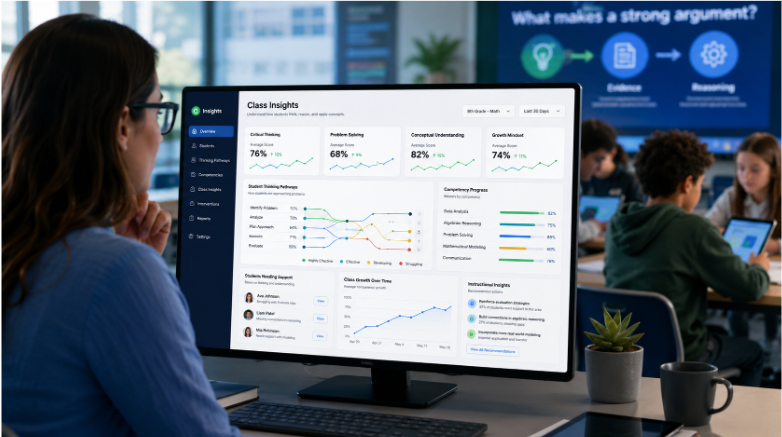
What if your dashboards could reveal more than what students finished and show how they approach real world challenges?
Your completion rates look good on paper. Students finish their programs and pass their assessments. Yet employers may still question whether some graduates can communicate clearly, solve unfamiliar problems, or adapt when something goes wrong.
The problem may not be what your students know. It may be what you cannot see.
Traditional dashboards can tell you whether students completed an activity, submitted an assignment, or passed a quiz. But these measures alone cannot show how a student approaches a difficult conversation, responds to unexpected information, or makes decisions in a realistic workplace situation.
For Career and Technical Education (CTE) leaders, this creates an important question: How do you know whether students can apply what they have learned when the situation changes?
The Measurement Gap in Career Readiness
According to the National Association of Colleges and Employers’ (NACE) Job Outlook 2025 report, employers identify critical thinking, communication, and teamwork as essential career-readiness skills. However, the same research shows significant gaps between the importance employers assign to these competencies and their perceptions of recent graduates’ proficiency.
For CTE programs, these findings highlight the importance of preparing students to do more than demonstrate knowledge. Students also need opportunities to practise applying their skills in unfamiliar situations.
Completion rates and assessment scores remain important. They simply do not tell the whole story.
A student may understand the principles of professional communication but struggle to respond to an upset customer. Another may know the steps involved in resolving a problem but find it difficult to decide what to do when the information is incomplete.
Both students may complete the same assignment. Their approaches to the situation, however, may reveal different learning needs.
To support career readiness, educators need opportunities to observe students applying their skills, not just completing activities.
What York Tech’s Experience Reveals
York County School of Technology in Pennsylvania offers an example of how interactive simulations can support practical skills development in CTE.
Beginning in March 2025, students in York Tech’s Education program participated in interactive simulations involving virtual parents and students. The scenarios gave aspiring educators opportunities to practise professional communication and decision-making in challenging classroom situations.
Rather than relying exclusively on traditional role-playing or case studies, students could interact with simulated characters and practise responding to different situations.
What students reported
According to the York Tech case study:
- 8.8 out of 10: Student engagement rating.
- 8.5 out of 10: Student rating of perceived effectiveness for real-world interactions.
- 85%: Students who preferred the simulations to traditional role-playing or case studies.
These results highlight students’ positive perceptions of the simulations and their value as an engaging way to practise real-world interactions.
The accompanying qualitative feedback described greater confidence and awareness of communication strengths and areas for improvement.
The implementation also expanded beyond the initial paid pilot into a three-year, school-wide implementation. That expansion shows continued adoption following an initial CTE pilot, which is a useful signal of the program’s value to the school.
Why this matters
The York Tech experience illustrates how simulations can create additional opportunities for students to practise professional interactions before encountering similar situations in real settings.
For future educators, that might mean practising a difficult conversation with a parent. In other CTE pathways, it could mean responding to a customer complaint, asking a supervisor for clarification, or explaining a decision to a colleague.
The specific situations differ by occupation. The underlying need remains the same: students benefit from opportunities to practise applying their knowledge, reflect on their responses, and try different approaches.
What Better Teacher Insights Can Reveal
When students participate in interactive, scenario-based learning, educators have opportunities to observe aspects of performance that completion-focused dashboards may not reveal.
Reasoning and Decision-Making
Evidence from interactive activities can help educators examine the decisions students made, the information they considered, and the sequence of their actions. Did a student gather information before acting? Did they consider alternatives? These observations can help teachers identify where students may need additional guidance or practice.
Communication in Context
Communication involves listening, asking questions, responding appropriately, and adjusting an approach to suit the situation. In simulations involving interactive characters, students have opportunities to practise these skills in context. Teachers can use available evidence to help students reflect on their communication choices and identify areas for improvement.
Problem-Solving Approaches
Workplace problems rarely arrive with every detail clearly explained. Students may need to clarify a request, evaluate available information, consider possible solutions, or decide when to seek assistance. Educators can use available performance evidence to identify where a student approached a problem effectively and where additional instruction may help.
Adaptability and Professional Judgment
A conversation can take an unexpected turn. A customer may become frustrated, a colleague may disagree, or new information may change the best course of action. Educators can observe how students respond within the simulation and use those observations to guide reflection and further practice.
From Practice to Targeted Instruction
Evidence becomes more useful when teachers can connect it to their next instructional decision.
A practical cycle has four stages.
Observe. Students participate in realistic scenarios requiring them to apply knowledge, communicate, and make decisions.
Review. Teachers examine available evidence and identify patterns in student performance.
Guide. Educators use specific examples to help students understand their strengths and identify areas for further practice.
Repeat. Students return to relevant activities, try different approaches, and continue developing their skills.
Consider a student who moves quickly to a solution without first clarifying a customer’s problem. Instead of giving only general advice about communication, a teacher can use the scenario to discuss the importance of gathering information before acting. The student can then practise again.
This approach connects observation with instruction.
How MegaMinds Supports Authentic Practice
MegaMinds helps students connect classroom learning with the communication, decisions, and responsibilities they may encounter in future careers.
Through browser-based interactive simulations, students engage with scenarios involving interactive characters. They practise responding to situations, make decisions, receive feedback, and revisit activities to strengthen their skills.
Teachers can use available platform evidence to support instruction and review student progress.
The platform provides educators with access to performance information and competency tracking. This gives teachers additional context for understanding student participation and performance beyond a simple completion indicator.
Where applicable, teachers review evidence across activities, verify demonstrated competency, and approve microcredentials when warranted. These recognitions document skills demonstrated within MegaMinds; they are distinct from external industry certifications and licenses.
The evidence supports educator judgment rather than replacing it. Teachers remain responsible for interpreting student performance, deciding what further instruction is appropriate, and connecting simulation experiences to course objectives.
From Completion Data to Evidence of Learning
Completion data helps educators understand whether students have finished assigned activities. But career readiness also requires opportunities to apply knowledge, communicate effectively, and make decisions in realistic situations.
Interactive simulations give students a structured environment in which to practise these skills. When teachers can review relevant performance evidence, provide targeted feedback, and create opportunities for further practice, that evidence becomes a useful part of the learning process.
York Tech’s experience offers an example of how simulations can be incorporated into CTE education. The broader opportunity for CTE leaders is to connect authentic practice with meaningful instructional insight.
MegaMinds helps schools bring real-world practice into the classroom through interactive simulations and insights designed to support teaching and learning.
See how MegaMinds can help your students practise career-ready skills and give educators more meaningful evidence to inform instruction.
Sources
National Association of Colleges and Employers. (2025). Job Outlook 2025. View the NACE Job Outlook 2025 Report
York County School of Technology, Pennsylvania. (2025). CTE Education Program Implementation with MegaMinds Interactive Simulations. Case study documentation on file with MegaMinds Inc.