

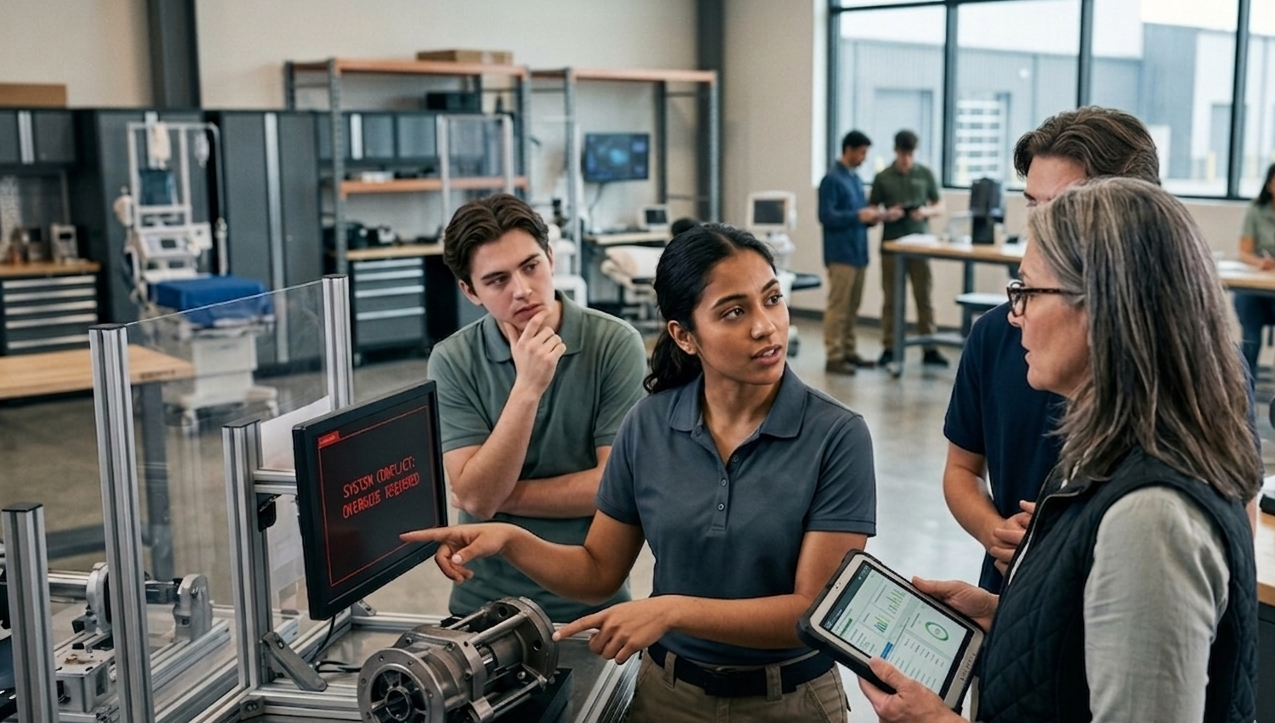
Career and Technical Education is at an inflection point. The expectations of the modern workforce are shifting from who knows the most to who can think, communicate, and adapt the best. In this piece, we explore why human capability has become the new currency of the workforce and how immersive learning can help CTE directors build it at scale.
The First Day Test: When Knowledge Alone Is Not Enough
A student walks in on day one. Trained. Certified. Confident.
Then the data contradicts itself. The supervisor changes direction mid task. A workplace system flags something that does not look right. The client wants something different from what the instructions say.
At that exact moment, every hour spent on procedural mastery either pays off or exposes its limits. Because what the student needs now is not another step in a checklist. They need judgment. Clarity under pressure. The ability to communicate with a supervisor who does not have time to repeat themselves. The ability to decide without certainty and own the outcome.
Technical skill got them in the door. Human capability determines whether they stay.
Why Traditional Training Falls Short
Many training programs still emphasize procedural accuracy inside controlled environments. This approach produces consistency, but it does not prepare students for complexity.
Real workplaces are dynamic. Tools and systems change frequently. Information provided by workplace systems can be incomplete or incorrect. Decisions often must be made without full certainty.
Employer research consistently shows that technical skill now functions as a baseline expectation rather than a differentiator. Long term performance depends on how individuals think, communicate, and respond when situations deviate from the plan.
Career and technical education is positioned closer to real work than any other part of the education system. The constraint is not access to industry context. It is how training content is designed and how readiness is assessed.
What Employers Expect That Most Programs Are Not Delivering
Across sectors, employers have largely stopped treating technical skill as a differentiator because they already assume it. What they cannot find enough of are graduates who demonstrate these four capabilities under real conditions. These are the traits they remember when they decide whether to hire from your program again.
Decision making with incomplete information means reasoning well without perfect clarity and committing to a defensible choice.
Communication that adapts involves speaking differently to a supervisor, a peer, and a client. It means knowing when to ask, when to push back, and when to listen.
Critical evaluation of workplace information matters because digital tools and automated systems are increasingly common. Employers need people who know when to trust the information they receive and when to question it, rather than people who accept an answer simply because a system produced it.
Accountability with consequences is more than knowing that a decision matters. It is being able to explain why a decision was made at the moment.
These are not soft skills. They are operational requirements. They are consistent expectations across healthcare, manufacturing, business, technology, IT, and every other industry your programs serve.
The Data Behind the Demand
According to the 2025 New Hire Readiness Report from the United States Chamber of Commerce, 92 percent of hiring managers believe high schools should place greater emphasis on business and workplace readiness.
MegaMinds does not provide business courses. It provides experiential exposure to how workplace decisions feel in practice. Through immersive simulations, students encounter situations that require judgment, communication, and accountability rather than memorization of concepts.
Turning Human Skills Into Observable Competencies
The challenge has never been recognizing the importance of human skills. The challenge has been teaching and measuring them.
Judgment, communication, empathy, and ethical reasoning do not develop through lectures or multiple choice tests. They develop through practice in situations that resemble real work.
This is where immersive learning becomes essential.
MegaMinds provides a framework that allows human capability to be practiced and observed rather than assumed. Students enter realistic workplace simulations using standard school devices. Inside these environments, they must speak, decide, justify their reasoning, and adapt as conditions change.
Communication becomes visible because students use their own voice. Reasoning becomes visible because decisions unfold over time. Educators do not see only final outcomes. They see how choices were made and how students responded under uncertainty.
This shifts assessment from guessing readiness to observing it.
In one scenario, a student must respond to conflicting signals between information provided by a workplace system and a client’s stated needs. The student must speak, explain their reasoning, and decide how to proceed. Educators can then review how the student communicated, how they justified their decision, and how they handled uncertainty. This makes workplace readiness observable rather than assumed.
That kind of practice only scales when the environment behind it is built to support it. Immersive learning requires student data. Student data requires protection. MegaMinds is built to meet the data protection standards required by large public school systems in the United States. The platform aligns with the Family Educational Rights and Privacy Act and the Children’s Online Privacy Protection Act. Role based access, audit trails, and secure infrastructure are not features added on top. They are the foundation that allows a district to move from a single pilot classroom to program wide adoption without compromising student safety or institutional trust.
Security does not slow progress. It is what makes progress possible at scale.
Strategic Leadership for Career and Technical Education Directors
Directors are no longer just administrators. They are architects of workforce readiness.
Programs that surface and measure judgment, communication, and adaptability earn employer confidence. Programs focused only on tool specific mastery produce graduates who struggle when conditions change.
Success in 2026 will be measured by graduates who can think clearly, communicate effectively, adapt under pressure, and exercise judgment when outcomes matter. Career and technical education must lead the shift from teaching tools to developing human capability.
The gap between what programs deliver and what employers actually need is not closing on its own. The directors who close it will not do it by adding another course or updating a curriculum checklist. They will do it by changing what readiness looks like inside their programs entirely.
About MegaMinds
MegaMinds partners with CTE programs to help students build judgment, communication, and adaptability through interactive, immersive simulations featuring realistic workplace scenarios and interactive characters. By turning human centric skills into observable, measurable competencies, MegaMinds equips schools to close the gap between classroom preparation and real world performance.
Ready to surface human capability at scale? Learn how MegaMinds can help strengthen your CTE program. Contact us to explore how immersive learning can prepare your students for workforce readiness.